

Tropical Forest: An Overview
According to the World Resources Institute, despite the fact that deforestation only accounts for 8% of the total global emissions, it has the potential to provide 23% of the climate mitigation solution. In particular, the conservation, restoration, and improved management of tropical forests are some of the most cost-effective mitigation strategies. It has the potential to deliver 63 % (7.1 Gt CO2) of the land sector’s cost-effective mitigation potential by 2030, in contrast to the sequestration opportunity offered by the management of temperate and boreal forests, which can deliver 1.4 Gt CO2 of climate mitigation.
Colonialism and Deforestation in the Philippines, 1565–1945
The Philippines is one of the world’s biodiversity hotspots, which also makes it one of the top conservation areas. Deforestation in the Philippines is intricately linked to the history of colonialism. During the Spanish colonial period from 1565-1898, lowland forests were logged due to their easy reachability and the quality of the timber they produced, which was often used for building houses, churches, and ships. Although data on the colonial forestry records during the Spanish regime were largely lost due to fire and warfare, the generally accepted estimation is that the forest cover at the start of the Spanish regime was over 90 percent, and it declined to around 70 percent by the end of Spanish rule. In 1899, the U.S. took over the Philippine archipelago and established the Insular Bureau of Forestry in 1900. Given that the U.S. was exhausting its own domestic timber reserves by the turn of the twentieth century, Americans turned their attention towards the relatively abundant primary forests in their new overseas territory. Thus, with the introduction of modern mechanized commercial logging, the deforestation rate in the Philippines accelerated. It is estimated that in the short span of less than half a century, from 1903 to 1950, the forest cover dropped from 70 percent to 50 percent. From the year 1902, Filipino insurgents were condemned as wartime criminals and later turned into prisoners who provided the labor to clear the “virgin” rainforest for establishing plantations and to build an extractive infrastructure for copra exports to the U.S. Tropical products, including sugar and fruits, were systemically planted in the landscape, and then sent on the conveyer belt towards the customers in the imperial core. After four centuries of forest exploitation under Spanish, American, Japanese, and authoritarian regimes, today less than 1% of old-growth dipterocarp forest has survived the anthropogenic colonization of the biosphere.
Rainforestation as Botanical Decolonization
“Botanical decolonization,” is a term coined by Mastnak et al. Given that colonization often entailed the uprooting of indigenous people and plants and that we continued to live in the legacy of botanical colonization, they argue that “native plant advocacy” in California is an act that can contribute to the larger and longer process of botanical decolonization. I would argue that rainforestation practice in the Philippines, which aims to restore the Philippine forests by using native tree species, including many species of Dipterocarps, is a move towards botanical decolonization. Pioneered by Prof. Milan and her colleague Joseph Margraf at the Visayas State University on Leyte Island, the practice of rainforestation aims to combine native species advocacy with the farming of economical crops, such as mangosteen, Aquilaria, and durian, to provide forest-dependent communities with additional sources of livelihood. Since the severe degradation of the Philippines’ forests can be traced back to four hundred years of ecological and land-use disruptions by profit-driven colonially established plantations, replanting native species to restore ecological function and biodiversity in the forest to support the sustainable livelihood of the rural poor is a fundamentally decolonial act. By emphasizing the non-economic benefits of planting native trees as well as the importance of diversifying the landscape, rainforestation aims not only to sustain ecological balance but also to restore the well-being of local communities.
In the summer of 2023, I visited the rainforestation sites in Leyte to gain practical knowledge of tropical forest conservation, restoration, and sustainable use. With a group of ELTI participants, we collected and propagated critically endangered forest tree species, and we established a wilding recovery chamber. We also planted saplings with the children from the Boy Scouts of the Philippines. Dr. Guiraldo Fernandez, one of the professors at VSU, explained that teaching children environmental education by having them help with planting trees aligns with the philosophy of “learning by doing.” The first-hand experience of how to care for saplings and how to make sure the trees grow healthy will become an invaluable experience for them as adults. With the help of the Filippno children, we returned the indigenous trees to the land where they would naturally thrive. Planting native tree species; planting hope.
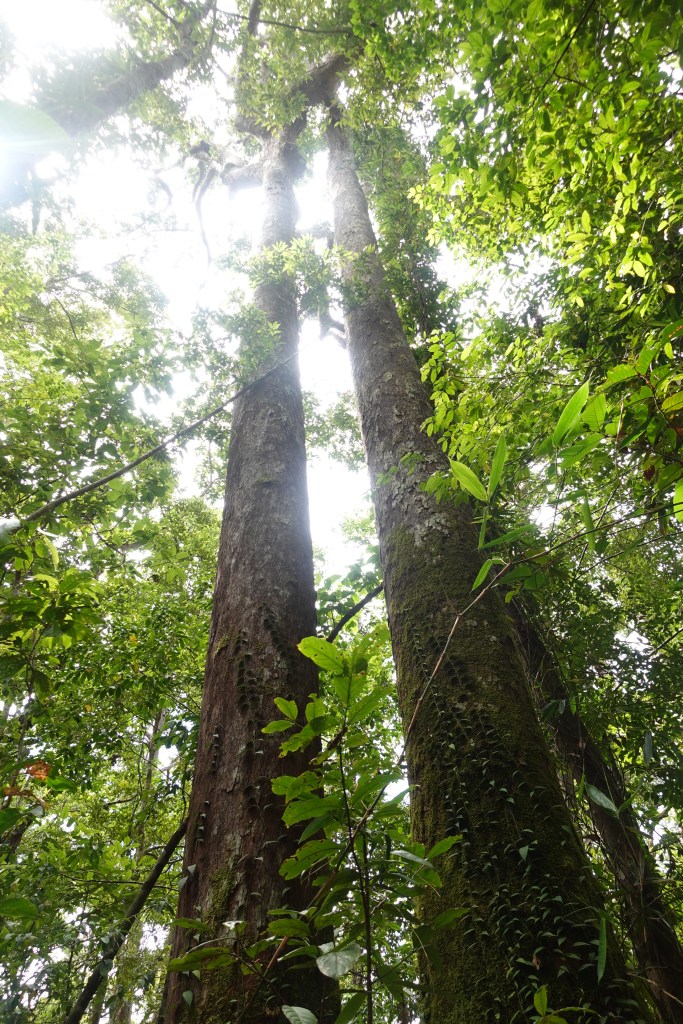
Finding the Dipterocarp mother tree. Mount Nacolod, Katipunan, Southern Leyte. Photo by Angie Hsu
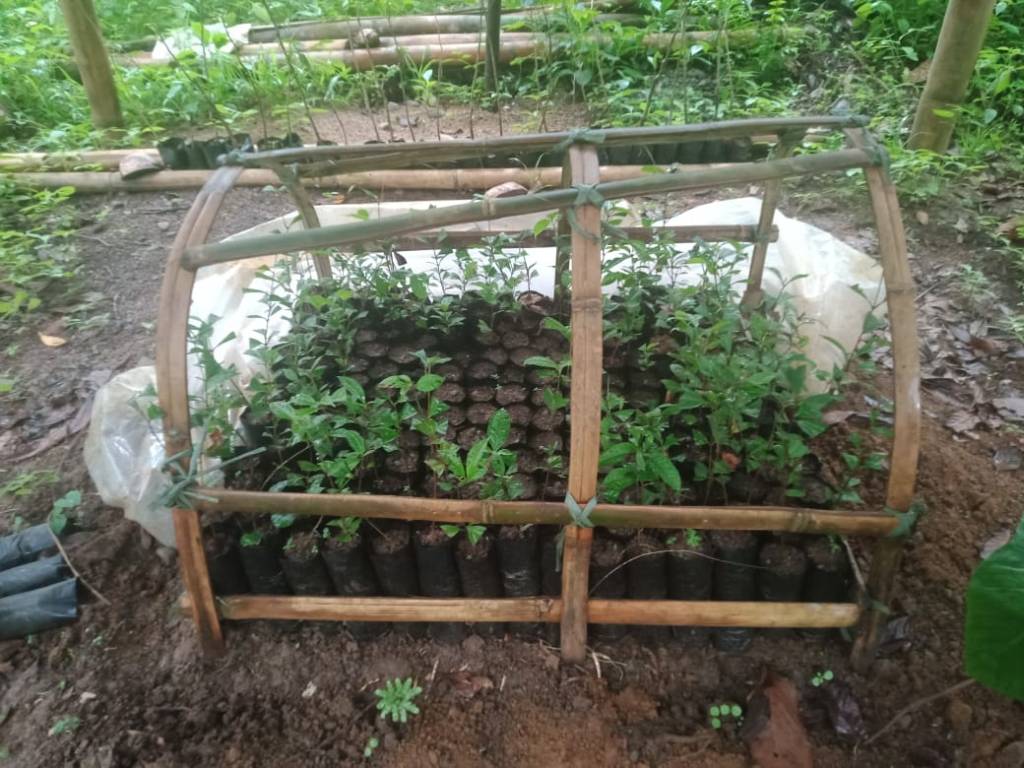
Wilding Chamber at Kambonggan Farm, Baybay City. Photo by Dr. Guiraldo Fernandez
Grassroots Environmental Movement in the Global South
In Slow Violence and the Environmentalism of the Poor, Rob Nixon points out that it is often the underprivileged populations in the global south who become the principal causalities of environmental disasters. However, their struggles and stories are often neglected due to the mainstream media’s representational bias. The Philippines is situated in the tropics and is particularly vulnerable to the impacts brought by tropical cyclones, such as flash floods and landslides. In April 2022, a massive landslide occurred after the tropical storm Megi, also known as Agaton in the Philippines, battered the Leyte region. The devastating landslide in Mailhi wiped out a local barangay (neighborhood) in Pilar, causing many cases of death and injuries. This was not the only landslide event that has displaced and destroyed local populations. Thirty years ago, another even more devastating event took place on the morning of November 5th, 1991, when typhoon Uring battered the city, causing nearly 8,000 casualties.[1] The landslide and the flash flood are the tragic outcomes of extreme weather events combined with the long-term displacement of forest landscapes and the destruction of diversity in the watershed area. As our planet warms up and extreme weather events intensify, rainforestation is one of the best strategies for mitigating the potential impacts of climate change in the tropical archipelago because native forests can maintain a healthy ecosystem by absorbing surface water runoff and thus preventing landslides. After three decades of implementing the practice of rainforestation amongst VSU staff, local farmers, and landowners, the rainforestation sites demonstrated that using native tree species can contribute to habitat restoration, enhance biodiversity, improve soil physical and chemical properties, empower the local community, and provide a stable income for farmers and adaptors. Far from being powerless in the face of climate disasters, people in the central Philippines roll up their sleeves to take up the challenge of restoring their own landscape and mitigating the impacts of climate change. The grassroots environmental restoration practices in the Philippines reveal that, with the necessary skills, patience, and determination, any citizen can create a man-made native forest from scratch. Thus, this article would conclude by arguing that rainforestation not only restored the tropical forest landscape but also the agency of the marginalized poor in the global south.
 A democratic space for sharing stories on replenishing the Earth