
The Rights of Nature, Indigenous Peoples, and Slow Justice
Interview with
Prof. Jérémie Gilbert
Legal Scholar at the University of Roehampton, UK
I asked the indigenous community with whom I am working, “Are you sure you don’t want to give up because the process of fighting for justice is so slow?” And his answer was very nice. He said, “You know, Jérémie, we’ve been there for a few centuries. For us, ten years is nothing. We have had injustices for thousands of years. So waiting for ten years to get a sense of justice? We can do that.”
“We are too obsessed with having quick, fast results when actually what matters is the long term, taking the time to leave around with the elements, and making more connections between the scale of the planet, the natural environment, and the earth, in contrast to the human beings that are there only for a few years. This is why the idea of ‘Slow Justice’ is so important for the work that we do on the ground.”
—Jérémie Gilbert
The Rights of Nature
Rights of Nature (RoN) is an ongoing legal movement that argues that nature possesses fundamental rights for its intrinsic value. This law aims to protect nature from the destruction of pollution and development. Proposed by the environmental scholar Christopher Stone in his book Should Trees Have Standings? as well as Thomas Berry in his work on earth jurisprudence, RoN was written into the constitution of Ecuador in 2008. Since then, more countries soon followed Ecuador’s lead; RoN is currently recognized in Bolivia, Columbia, India, New Zealand, and Uganda.
Indigenous Human Rights
Indigenous human rights stipulate that indigenous communities have fundamental property rights and the right to give Free Prior Informed Consent (FPIC) before any developments can take place on their land. Although the framework of Indigenous human rights challenges the neo-colonial idea that the state can decide if indigenous lands are bought, sold, and exploited for the extraction of natural resources, it still fundamentally depends on the idea of seeing land and nature as property rather than recognizing their inherent value.
Slow Justice
In response to the “slow violence,” as environmental humanities scholar Rob Nixon defines it, Jérémie proposed that slow justice is the best way to dismantle colonial legacies and address systemic racism that has been embedded in the neocolonial system. Since colonialism dominated the world in the past 500 years of history, it most likely required a long period of time for systemic changes to happen.
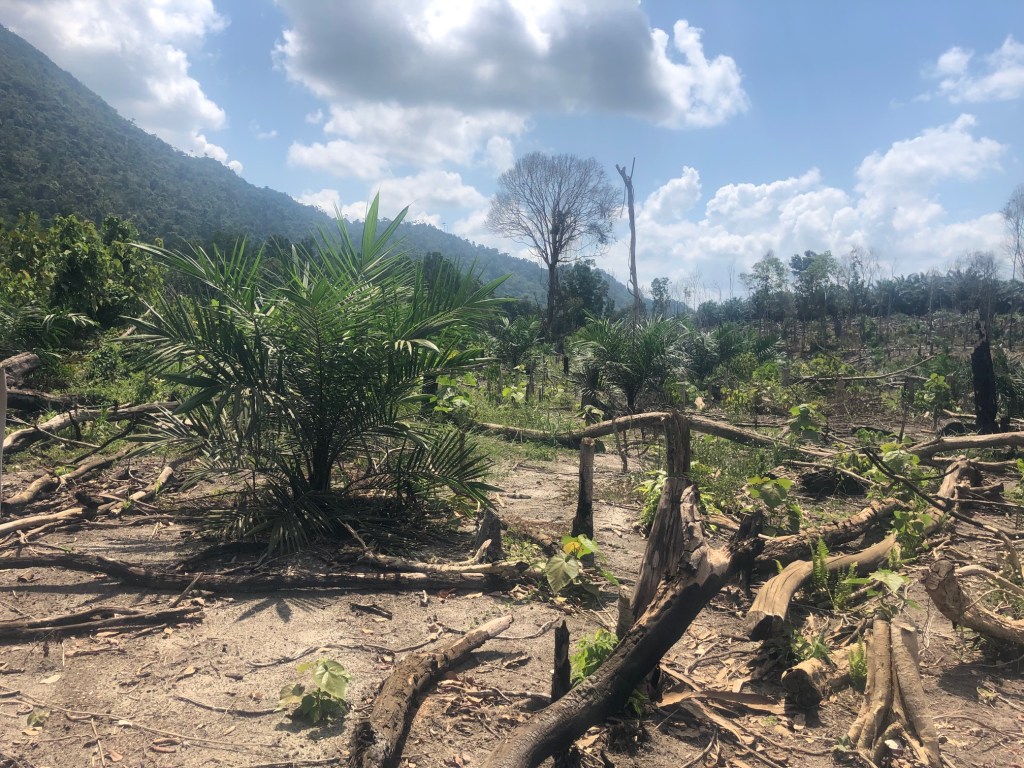
Slow violence and the transformation of tropical forest landscape: Indigenous forest burnt down for the establishment of palm oil plantation in West Kalimantan, Indonesia.
Development is a form of slow violence
Although not all types of development are inherently bad for the communities (for instance, healthcare services are the exceptions), development that takes the form of colonial exploitation has been devastating to indigenous peoples around the world. This is because many developmental projects promoted by the state are still operating upon the colonial idea of utilizing land as property in a way that maximizes profits. In postcolonial and settler-colonial societies, indigenous people often suffers from the state’s aggressive development agenda where the state claim entitlement of indigenous lands for the purpose of resource extractions.
In our discussion, we also argued that development in the form of cultural assimilation is also an act of slow violence. Even though the assimilation process might seem quite benign on the surface, it’s slowly killing indigenous peoples’ languages, identities, and cultures. Institutions like the boarding schools in America, Canada, and Australia aim at erasing and destroying indigenous worldviews and cosmologies to create cultural uniformity and promote a homogeneous national identity. The insidious processes of assimilation have driven many indigenous peoples into high rates of suicide, alcoholism, and poverty. Suffering from deep traumas of colonialism and the lost sense of self, indigenous peoples need the time to heal their historical wounds.
Slow violence demands slow justice!
The role of arts and storytelling in supporting the rights of nature
“I think the legal system is too drawn to the classical evidence; in court, you need to prove things with paperwork. Right of Nature is going around that saying, storytelling, and traditional arts form, such as representing nature in poems or paintings. All of these are values of relationship to the natural world, which themselves should be recognized as having an expression to that legal world.”
 A democratic space for sharing stories on replenishing the Earth