
Terrapolis Manifesto
A Democratic Space For Sharing Stories on Replenishing the Earth
Democracy, in its current form, is collapsing inward. Once imagined as a space of collective freedom, it is now often wielded as a weapon of exclusion—fortified by nationalism, hollowed by capital, and deaf to the living world that sustains it.
Across the globe, democracies are breeding on borders. The language of national identity has become a chorus of division—“us” against “them,” citizen against migrant, human against more-than-human. In the name of sovereignty, rivers are dammed, forests felled, animals driven to extinction, and entire ecosystems stripped of their agency. The right to vote becomes the excuse to silence those who cannot.
But what if democracy was never meant to be just a state? What if it is, instead, a commons of voices—messy, plural, open-ended, and ecological? A place where not just humans, but also watersheds, birds, fungi, forgotten seeds, ancestral knowledge, and future beings are acknowledged as part of the conversation?
It is not ruled by elections or governed by parties. It does not enforce coherence. It listens. It asks difficult, slow questions: What does justice look like in a forest? What does consent mean to a migrating whale? Who speaks with the rivers?
In Terrapolis, we practice radical attention to the living world—a listening across species, scales, and stories. It is not about majority rule but about relational belonging. Not about enforcing sameness, but honoring interdependence. This is not idealism. It is remembering what modern democracies have forgotten: that no constitution, however liberal, can guarantee life if it forgets the soil.
Terrapolis Manifesto: A Commons of Voices
Terrapolis is not a state.
It is not defined by borders or guarded by laws of nationhood.
It is what Bruno Latour once called a Parliament of Things—
a gathering place where humans do not speak alone.
Here, rivers petition.
Mangroves murmur.
Gibbons withdraw in protest.
The soil carries memory.
In Terrapolis, no actor stands alone.
A climate scientist, a herder, a coral reef, a virus—
all belong to the same web of becoming.
This is actor network theory in motion:
Every being, tool, law, or species is an actor in the unfolding world.
There are no backstage observers—only entangled participants.
We reject the narrow democracy
that places humans at the center,
that elects without listening,
that exploits the Earth while claiming to represent it.
Terrapolis is not a Polis of votes,
but a commons of voices.
Here, citizenship is shared with the more-than-human world.
Representation is not symbolic—it is material, lived, and reciprocal.
We do not seek harmony through uniformity.
We embrace messy entanglements,
multiple truths, and nonhuman agencies.
This is not utopia.
It is diplomacy among beings.
It is governance through attention,
through consent that is felt rather than signed.
Terrapolis lives
where anthropocentrism subsides, where land are rewilded,
where forests remember their mycelial ties,
where technology becomes a companion to listening.
It exists
in the pulse of shared responsibility,
in the refusal to forget the displaced and dispossessed,
in rituals of repair
and acts of re-communing.
It is the future that almost didn’t arrive—
but still could,
if we learn to speak less
and hear more.
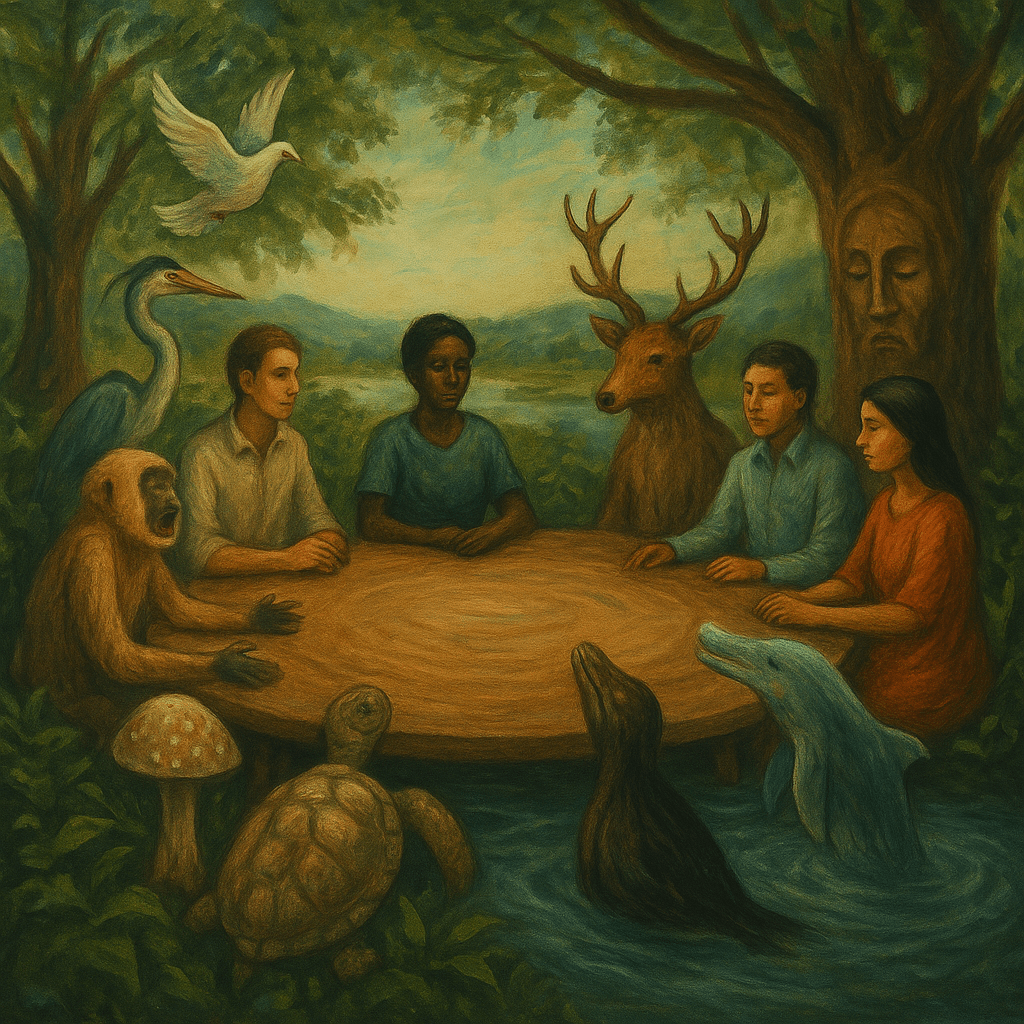
The Parliament of Things
Illustrated by Mira Mycelius, 2025 © All Rights Reserved
 A democratic space for sharing stories on replenishing the Earth